




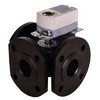
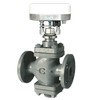
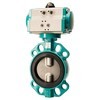
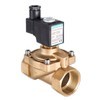
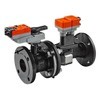
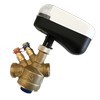
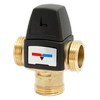


Motorized Valve Capacity and Diameter Selection Based on kcal/h Value
To calculate valve capacity and select the correct valve diameter, please enter the required data in the calculation area below.
If the temperature difference (°C) and pressure drop (kPa) values are not known, the following standard values may be used:
- For heating systems: Temperature difference: 20 °C, Pressure drop: 10 kPa
- For cooling systems: Temperature difference: 5 °C, Pressure drop: 20 kPa
A valve with a value lower than the calculated Kvs value should not be used. It is normal for the valve to be one size or maximum two sizes smaller than the pipe diameter of the installation.
Valve Capacity Calculation
Correct Motorized Valve Selection in HVAC Applications
In HVAC installations, motorized valves are among the most important components for fluid and ambient temperature conditioning. In addition to their main purpose, motorized valves today can also offer additional functions in line with market requirements and competitive demands.
These functions include the management of differential pressure and flow control, which are important for maintaining temperature comfort conditions. This article focuses only on the selection and control parameters of motorized valves operating based on temperature control.
Basic Operating Principle of a Motorized Valve
Let us consider a motorized control valve system diagram through a heating system example commonly encountered in the field. In a typical residential heating installation, the system consists of two circuits: the primary circuit and the secondary circuit. The heat exchanger separating these two systems provides the desired temperature set value on the secondary side through the motorized control valve located on the primary side.
The motorized valve is controlled by an electronic controller in the system. The system compares temperature values and sends the required control signal to the motorized valve.
Valve Control Characteristics
Valve characteristic refers to the relationship between valve stroke control, meaning the valve opening, and the flow rate passing through the valve under constant pressure. The choice of linear, logarithmic, or split characteristics depends on the requirements of the application.
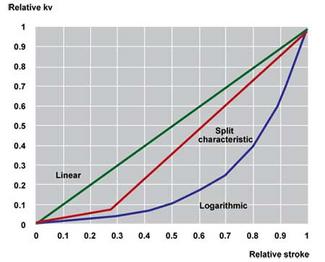
The main purpose of logarithmic-characteristic motorized valves, which are commonly used in the industry, is to provide more linear and balanced heat transfer control for heat terminal units that have logarithmic characteristics.
Valve Control Theory
The most important definition encountered in the selection of motorized control valves is the Kvs value. In motorized valve sizing, the Kvs value is related to the flow rate and the differential pressure across the valve.
Therefore, valve selection should not be based only on the pipe diameter. Capacity is a function of the flow rate passing through the valve and the differential pressure across the valve.
To ensure that the valve actuator can control the differential pressure across the valve, the maximum operating differential pressure value of the actuator for the relevant diameter must be checked.
Valve Authority
Valve authority is a dimensionless term that expresses the ratio of the valve pressure drop to the total pressure loss in the installation where the valve is installed. Higher valve authority allows the valve to operate more stably and enables more precise temperature control.
- For 3-way valves: Valve authority should preferably be greater than 30%.
- For 2-way valves: Valve authority should preferably be greater than 50%.
On/Off Control
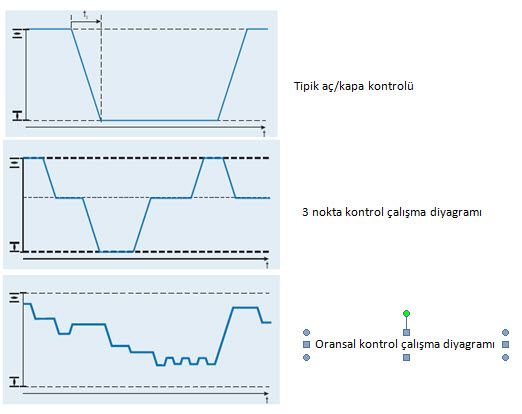
On/off motorized valves are used to either fully allow or completely stop fluid flow. They are generally preferred for shutting off or isolating a line in the installation.
3-Point Control
In 3-point control valves, the valve stem is moved to the desired position using open, close, or stop signals coming from the system. They may be used in installations where less precise regulation is required.
Proportional Control
Proportional control is one of the most common control methods used in precise closed-loop installations. The control signal is transmitted as 0(4)-20 mA or 0(2)-10 V. Since it can provide precise control even at low flow rates, it is preferred under variable fluid conditions.
In summary, the most important parameter in motorized control valve selection is determining the correct valve body capacity for the application. Then, the valve authority must be ensured to be within the suitable range for the installation, the differential pressure close-off value specified by the manufacturer must be checked, and the most suitable actuator control type should be selected according to the application sensitivity.
